
If you spend any time around the tiny home world, you already know one thing: people love to talk about design, aesthetics, Pinterest boards… all the shiny stuff.
But the less glamorous stuff? The foundation, the engineering, the “will this whole thing actually stay on the road?” part?
Yeah, that gets ignored way too often.
And that’s where this whole conversation about an inflatable raft trailer and small homes really starts to get interesting. The short answer is no: these trailers weren’t built for tiny homes. Not originally anyway. But let’s be real… tiny house people are creative. Resourceful. They’ll convert anything if it means saving a few bucks and getting the freedom they want.
Still, here’s the truth: just because something can roll doesn’t mean you should build a home on it.
So, let’s unpack what an inflatable raft trailer actually does, why some folks look at it as a cheap shortcut, and why companies like Trailer Made Custom Trailers would politely (or bluntly) tell you:
“Don’t do it. Build smart. Build safe. Build for the long haul.”
Inflatable Raft Trailers 101: What They’re Made For
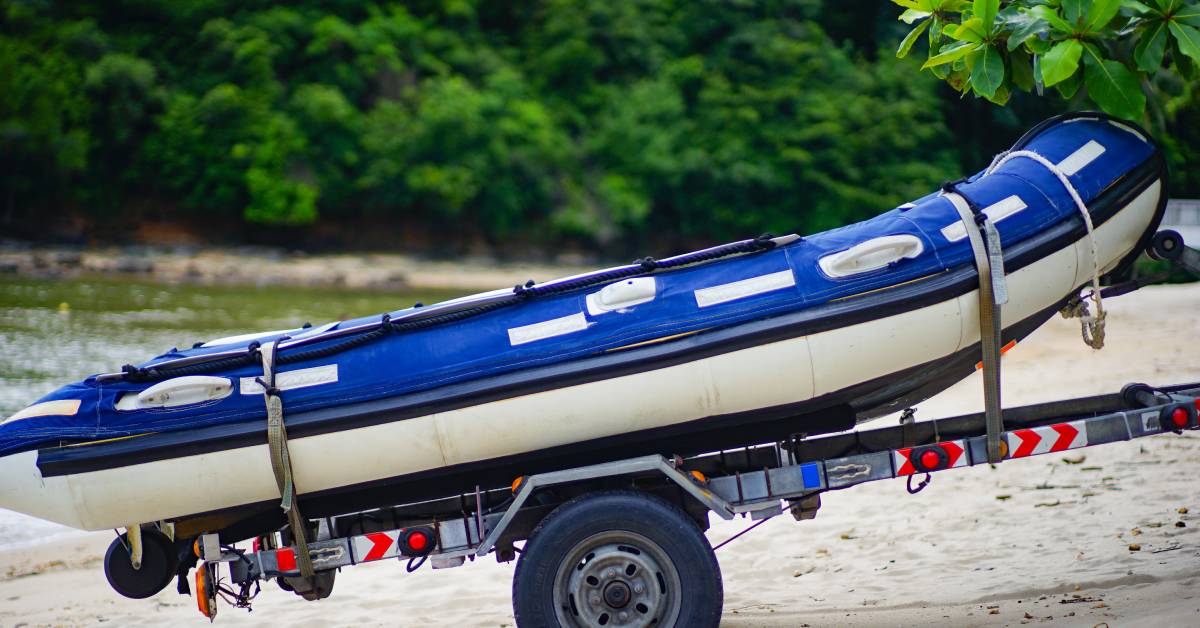
An inflatable raft trailer is pretty much what it sounds like. A light-duty frame designed to haul inflatable rafts, kayaks, maybe a couple of coolers, and a day’s worth of gear.
They’re good at that.
They aren’t good at… well… much else.
Look, these trailers have a purpose:
- Move something lightweight.
- Keep it stable enough on the road.
- Survive a few bumps and dips.
That’s it.
They’re not engineered to hold the weight of a tiny home shell, or an ADU for sale, or anything that resembles walls, framing, insulation, water tanks, electrical systems… You get the idea.
A tiny house, even a small one, isn’t “light.” People forget how heavy wood is. Or metal. Or appliances. Or the bathroom, you definitely want, because nobody wants a composting toilet on stilts.
So when someone says, “Hey, could I slap a tiny home on an inflatable raft trailer?”
You could.
People have done weirder things.
But you shouldn’t, and here’s why.
The Weight Game Tiny House Code Isn’t Optional
Ever read the tiny house code for your area?
Probably not. That’s okay, most people don’t. But the code exists for a reason. It keeps builders from putting 10,000 lbs of house on something rated for 1,000 lbs of fishing gear and paddles.
Inflatable raft trailers aren’t engineered for:
- Vertical loads
- Lateral loads
- Shear stress
- Motion stress
- Long-term sag
- Crosswind buffeting
- Or the 50 other things that tiny homes absolutely throw at a trailer
Tiny house code, building codes, even the guidelines for ADU builders, everything points to one message:
Your foundation matters. A lot.
Think of it like building a house on a marsh. You can do it. Just don’t expect it to behave like a normal house.
Trailer Made Trailers Engineered Foundations, Not Guesswork
Now, this is where Trailer Made steps in.
These guys aren’t building weekend raft haulers.
They’re building foundations.
A Trailer Made engineered tiny house trailer isn’t a “platform with wheels.” It’s a structural system.
A few standouts:
- Heavy-duty steel rated for real-world house loads
- Perfect axle placement to manage tongue weight
- Anti-flex engineering (big deal, nobody talks about it, but they should)
- True foundation-grade stability
- Long-term warranty-backed strength
- Custom builds for tiny house kits, ADUs, studios, off-grid homes
Put simply:
When you build on one of these, you’re starting the right way.
People talk all day about saving money by “getting creative” with a cheap trailer.
But the truth is this:
The most expensive build is the one you have to redo.
Why Some People Try Using Raft Trailers Anyway
I’ve seen people do it because:
- The raft trailer was cheap
- They already owned one
- They wanted to start “right now.”
- They liked the idea of lightweight builds
- YouTube makes everything look easy
But here’s where things start to go sideways. Literally.
Inflatable raft trailers:
- flex too much
- sway without warning
- Overheat axles under heavy load
- blow tires
- warp frames
- can’t handle highway wind
- fail inspection for any ADU or tiny house code
When you’re hauling kids or pets or even just your whole life in a tiny home, that’s not a risk worth taking. Not for a few hundred saved upfront.
Could a Raft Trailer Support a Micro Cabin? Maybe. Should it? Probably Not.
Let’s be fair.
If you were building something like an ultralight micro cabin… a shed-sized camping pod… a teardrop with foam walls… maybe you could get away with it. Maybe.
But even then, the question becomes:
Why gamble?
The moment you add:
- solar panels
- a small kitchenette
- water jugs
- a platform bed
- insulation
- framing
…poof.
There goes your weight limit.
And your stability.
Raft trailers simply aren’t designed for dynamic load-bearing. Houses move. They shift. They absorb road shock in weird ways.
Most inexpensive trailers aren’t even engineered; they’re just welded together and sent out into the world.
But Trailer Made Custom Trailers?
Different ballgame.
Think “built to carry a house,” not “built to carry toys.”
Engineered Trailers: The Quiet Hero of Tiny Homes
Nobody posts photos of their trailer on Instagram.
But it’s the most important part of the build.
An engineered tiny home trailer gives you:
1. Strength that lasts 20+ years, not 2 seasons
You’re not going to be tightening bolts every few months, praying it doesn’t rattle apart.
2. Perfect alignment and load balance
Tongue weight matters. Axle placement matters. Most DIYers guess wrong.
3. Safety at highway speeds
A tiny home is basically a sail. A 10,000-lb sail.
Your trailer better handle that.
4. True foundation-level stability
No flexing. No bowing. No surprises.
5. Resale value
People pay more for homes built on Trailer Made bases. They trust them.
Inflatable raft trailer? You’ll be lucky if a buyer even wants to tow it to the end of the block.
How an Inflatable Raft Trailer Actually Can Help Your Small Home Journey
Okay, so there are a couple of things these trailers are good for, just not as foundations.
1. Transporting Materials
These lightweight trailers are nice for hauling lumber, insulation rolls, tools, or the foam boards for your tiny home shell.
2. Moving Your Recreational Gear
Your tiny home might live on a Trailer Made engineered trailer, but your toys, kayaks, SUP boards, and inflatables can ride on the raft trailer.
3. Backup utility trailer
Every off-grid or mobile-living setup benefits from a secondary mini-trailer. They’re useful for trash runs, material runs, gear runs… everything.
4. A starter “tinkering platform”
If you’re new to DIY fabrication, raft trailers are a low-risk way to learn to weld, bolt, paint, etc.
5. Temporary transport for a prefab shell
Not ideal, but possible. You could haul a lightweight kit frame to your build site, then transfer it to a real engineered foundation.
The point is, raft trailers aren’t useless.
They’re just misused a lot.
Tiny Homes Require Real Foundations, Not Wishful Thinking
A tiny home isn’t just a cute cabin on wheels. It’s a structure. A shelter. A long-term living space.
You need something at the bottom that’s designed to:
- hold the load
- distribute the weight
- stay stable
- survive the weather
- two without drama
- meet tiny house code
- Stay straight for decades
Raft trailers do none of that.
Trailer Made engineered trailers do all of it and then some.
You want peace of mind?
Start with the right foundation.
You want to fix problems later?
Start with whatever you find on Craigslist for $400.
Your call.
Trailer Made The ADU Builder’s Silent Partner
The industry is full of ADU builders who quietly use Trailer Made as their foundation source. They don’t always brag about it, but they rely on it because it means fewer callbacks, fewer failures, and fewer structural headaches.
If you’re planning to sell an ADU or list a tiny home kit as a premium build, you can’t gamble on the trailer. Buyers expect engineered. Inspectors expect engineering.
Trailer Made gives you that.
Every single time.
Final Thoughts
People always want shortcuts.
It’s human nature.
But sometimes the shortcut is actually the long road in disguise.
Inflatable raft trailers have their place. They’re great for what they do.
But they are not, and never will be, the right foundation for a serious tiny home, ADU, or off-grid build.
If you want your home to last, tow safely, and actually be worth something years down the line…
You need a trailer engineered for the job.
And that’s where Trailer Made stands head and shoulders above the crowd.
Ready to build something that doesn’t fall apart, sway across the highway, or give you anxiety every time you hit 55 mph?
Start with the foundation that’s built for real homes.
Visit Trailer Made Trailers to start your build.
FAQs
1. Can an inflatable raft trailer support a tiny house?
Technically? Maybe a tiny shed-sized structure.
Realistically? No. Tiny house code and basic engineering make it clear that you need a true foundation-grade trailer.
2. Why is an engineered trailer better for tiny homes?
Engineered trailers are built to handle vertical and horizontal loads, tongue weight, highway stress, and the long-term weight of insulation, appliances, framing, and everything else a home needs.
3. What happens if I build on a cheap utility or raft trailer?
Flexing, sagging, axle failure, tire blowouts, instability, and usually a full rebuild within a couple of years. It’s a false “savings.”
4. Can a raft trailer still be useful for a tiny home project?
Absolutely. It’s great for hauling materials, tools, gear, and smaller project components.
5. Why do ADU builders prefer Trailer Made?
Engineered foundations reduce long-term issues, pass inspections, improve resale value, and support heavier ADU designs without structural risk.