
Most of the stuff you read online about making a tiny home energy-efficient is total garbage. You get these Pinterest-fueled blog posts written by folks who have never stripped a wire or stripped a screw, telling you to buy a bunch of solar panels or hang some thick curtains and call it a day.
Truth is, if you’re building or buying a tiny house for sale in Colorado, energy efficiency isn’t something you slap on at the end like a coat of paint. It starts right at the bottom.
I’ve seen thousands of builds. I’ve seen DIYers pour their life savings into beautiful reclaimed wood walls, top-of-the-line off-grid tech, and high-end tiny home kits only to realize their floor is freezing, their walls are warping, and their utility bills are higher than a traditional three-bedroom suburban home.
Why? Because they built their dream on a cheap, flexing foundation.
If your tiny home trailer flexes when you hit a pothole on I-70, your thermal envelope splits. Your spray foam cracks. Your window seals pop. Suddenly, all that expensive heat or AC you’re paying for is leaking out of microscopic structural gaps.
If you want a tiny house that doesn’t cost a fortune to run, you have to think like an engineer, not a decorator. Let’s break down how you actually build an energy-efficient compact living space that doesn’t bleed cash.
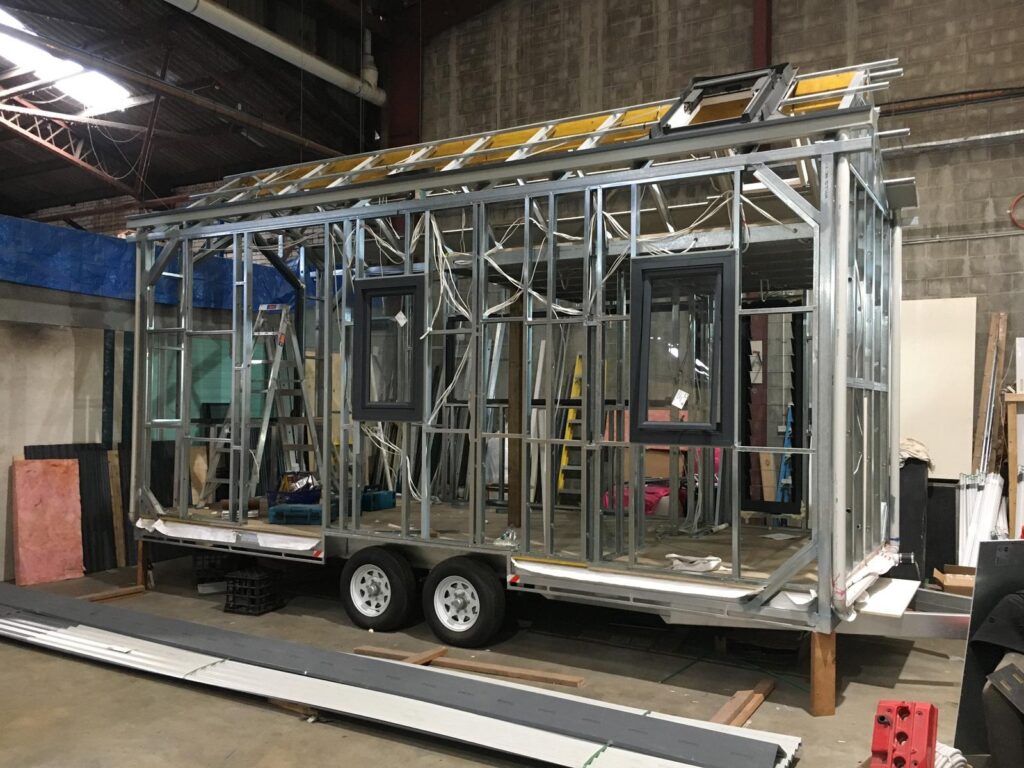
The Cold Truth: Your Foundation is Your Biggest Thermal Bridge
When people look at a tiny home for sale, they look at the kitchen counters. They look at the loft. They almost never crawl underneath to look at the chassis. That is a massive mistake.
Most standard utility trailers are built for hauling landscaping equipment or a couple of ATVs. They aren’t engineered to carry a 14,000-pound rolling house through Colorado winters. When you build on a cheap frame, the steel bends. But more importantly for your energy bills, standard steel is a massive thermal bridge. It sucks the cold right out of the frozen ground and radiates it up into your floorboards.
The tiny house experts at Trailer Made spent years engineering a fix for this. We don’t just weld some steel tubes together and call it a day. Our tiny home trailers for sale feature integrated, drop-down floor systems designed specifically to hold thick insulation without losing headroom.
- No exposed wood underneath: Cheap builds have plywood subfloors exposed to road debris and moisture. That wood rots, holds dampness, and ruins your insulation value.
- Thermal break engineering: Our frames allow you to properly isolate your living space from the steel chassis, cutting off that thermal bridge.
- Zero flex: Because our frames are engineered with specific crossmember spacing and high-strength steel, your structure doesn’t shift. If the structure doesn’t shift, your insulation stays intact, keeping your R-value exactly where it needs to be for the lifetime of the home.
If you are looking at tiny home kits for sale, look at what trailer they include. If it’s not an engineered, purpose-built tiny house trailer, walk away. You’ll spend more on heating bills over five years than you “saved” by buying a cheap foundation.
Insulation: It’s Not Just About R-Value, It’s About Air Sealing
The short answer to why most tiny homes are drafty is bad air sealing. You can buy the highest R-value insulation on the market, but if the wind can blow right through your wall cavities while you’re towing down the highway or sitting on a windy ridge in Colorado, it won’t do a damn thing.
In tiny home construction in Colorado, we have to deal with extreme temperature swings. Freezing nights, blazing summer days. You need an insulation strategy that handles both.
Closed-Cell Spray Foam vs. Everything Else
For a real-deal, long-term tiny house, closed-cell spray foam is usually the undisputed king. Here’s why:
- It adds structural rigidity: It glues the whole wall cavity together. When you’re moving your house, that extra stiffness keeps everything tight.
- It’s a vapor barrier and air seal in one: It expands into every tiny crack, meaning no drafts.
- Higher R-value per inch: Space is tight. You don’t have 6 inches of wall depth for traditional fiberglass batts. You need maximum performance in a 2×4 or cold-formed steel stud wall.
But here’s the catch: if you put closed-cell foam into a structure built on a flimsy trailer, that foam will crack over time from road vibration. Once it cracks, you lose the air seal. That’s why custom tiny homes in Colorado need to start on a rigid frame. Our lifetime warranty on Trailer Made chassis exists because we know our frames don’t flex enough to ruin your structural insulation.
The Rise of Cold-Formed Steel Framing
If you’re looking at tiny house builders near me, ask them if they work with cold-formed steel framing. At Trailer Made, we’ve leaned heavily into this. Steel studs don’t twist, warp, or rot like wood. They are perfectly straight, every time.
When you pair a steel frame with high-quality insulation and a proper thermal break, you get an airtight envelope that holds its temperature with barely any mechanical help. It means your mini-split runs on its lowest setting instead of screaming at full blast all day.
Windows and Doors: Don’t Buy Residential Off-The-Shelf Junk
Here’s another spot where DIYers and cheap tiny home contractors in Colorado cut corners. They go to a big-box home improvement store, buy standard residential windows off the clearance rack, and slap them into a house that’s going to travel 65 mph down the interstate.
Residential windows are designed for houses that stay still. They aren’t rated for the wind loads, vibrations, and frame twisting that happens during transit.
When those window seals pop, the argon gas escapes. Now you don’t have an energy-efficient window anymore; you just have a piece of glass that lets heat escape.
Look for commercial-grade or high-performance vinyl windows with a high design pressure (DP) rating. You want double-pane, low-E glass at an absolute minimum. Tri-pane is even better if you’re dealing with harsh Colorado winters. And make sure they are flashed and taped properly. I’ve seen water intrusion ruin thousands of dollars of insulation because someone didn’t want to spend an extra twenty bucks on proper flashing tape.
Mechanicals: Right-Sizing Your Climate Control
If you build an airtight envelope on a solid foundation, you don’t need a massive furnace. In fact, oversized heating and cooling units are terribly inefficient. They turn on, blast the house with air, shut off, and repeat. That cycle eats up power and destroys your equipment.
Mini-Split Heat Pumps
The go-to for any serious ADU builder or tiny house expert is a high-efficiency ductless mini-split system.
Pro Tip: Look for systems with variable-speed inverter compressors. They do not just turn on and off; they kind of idle down to match the precise heating or cooling load in the room, using less electricity, like a fraction of it.
They manage both heating and air conditioning at the same time, they take up almost no space and somehow they’re also really quiet. If you are building an ADU for sale, or even just thinking to use it as a rental property, a mini split is kind of a no-brainer, honestly. It keeps your tenants comfortable, and keeps your overhead on a short leash.
Heat Recovery Ventilators (HRVs)
When you build a tiny home properly, meaning you make it airtight, you run into a new sort of snag. Moisture buildup, basically. People breathe, you cook, you shower, and all of that adds humidity. In a small space, that dampness can trap warmth during the summer, and in the winter it can start giving you mold issues.
You can’t just open a window when it’s zero degrees outside. You need an HRV. This little machine swaps out stale indoor air for fresh outdoor air, but it passes the streams through a core that transfers the heat. You get fresh air without losing your indoor temperature. It’s non-negotiable for a truly energy-efficient, healthy compact home.
The Solar Trap: Why Efficiency Must Come Before Generation
Everyone wants to talk about solar panels. It looks cool on Instagram to have a roof full of solar glass. But throwing money at a massive solar array to power an inefficient tiny house is like buying a bigger bucket to catch water from a leaky roof. Fix the leaks first.
Once you minimize your energy load through a solid foundation, great insulation, and smart window choices, your solar requirements drop drastically. Instead of needing a massive, expensive battery bank and ten panels, you might only need three or four panels to run off-grid.
If you’re hooked up to grid power, a highly efficient build means your monthly utility bill could be less than the price of a decent dinner out. That’s how you get actual long-term value out of your investment.
Appliances: The Silent Energy Hogs
You can’t put standard appliances into a tiny house and expect your power bill to look good. Every watt counts when you are working with limited space and limited electrical service (often 30-amp or 50-amp feeds instead of a standard house’s 200-amp service).
- Induction Cooktops: Ditch the propane or old-school electric coils. Induction heats the pan directly via magnetism. It’s faster, safer, and doesn’t dump excess waste heat into your tiny kitchen, saving you money on AC bills in July.
- Heat Pump Dryers: If you’re putting a washer/dryer combo in your build, get a ventless heat pump model. Standard dryers vent your indoor, climate-controlled air right outside, forcing your heater or AC to work double-time to replace it. Heat pump dryers recycle the air internally.
- 12V Refrigerators: If you plan on traveling or using solar, look into high-efficiency 12-volt DC refrigerators. They run directly off battery power without needing an inverter to step the power up to 110V AC, which always wastes energy through heat loss.
Don’t Step Over a Dollar to Save a Dime
Look, there are plenty of places to save money on a tiny house build. Buy secondhand light fixtures. Hunt down a deal on tile for the shower. Do the interior painting yourself.
But do not cut corners on the things you cannot change later. You can replace a couch. You can swap out a faucet. You cannot replace a warped, rusted, sagging trailer frame once a 14,000-pound house is built on top of it.
When you start your build with a foundation from an industry leader like Trailer Made, you aren’t just buying steel. You’re buying the peace of mind that your structural envelope will remain airtight, secure, and energy-efficient for decades, whether it’s parked on a permanent lot as an ADU rental or being towed across the country.
Stop looking at cheap utility trailers and hoping for the best. Do it right the first time.
Visit Trailer Made Trailers to start your build and lay down a foundation that actually keeps your hard-earned money from leaking out the floorboards.
Frequently Asked Questions
How can better insulation improve the energy efficiency of a tiny home?
High-quality insulation such as closed-cell spray foam can provide a continuous layer of insulation over all the areas where you live. Air leakage doesn’t have a huge effect in a small home since there’s less air to start with, and a tiny draft can blow away all the heat in a matter of minutes. A well-insulated home retains the heat and does not allow air to escape, which reduces the time heating/cooling systems are running and maintains an indoor temperature. The insulation is only effective, though, when your foundation doesn’t flex and crack it, so an engineered, rigid trailer frame is required.
What are the best energy-efficient appliances for a tiny home?
The most energy-efficient appliances for small spaces are those that employ high-tech features that reduce power consumption. Use induction cooktops, which require cookware to conduct the heat to the food, instead of heating the air around the food. If you need laundry washing and drying, opt for a ventless model that re-circulates air within the machine rather than venting into your expensive, heated, climate-controlled indoor air outside. Last but not least, selecting Energy Star-rated electronics and refrigerators, or 12V DC appliances when operating on solar, will greatly reduce power usage throughout the day.
How do solar panels benefit a tiny home’s energy consumption?
Solar panels don’t actually produce a negative effect on your home’s energy usage, but by providing energy independence, they remove or significantly lower your energy bill from grid usage, which takes away the need for electricity from the grid. When you design and construct your tiny house to be very energy efficient from the ground up with a tight building envelope and energy-efficient mechanical systems, you will require fewer solar panels and a smaller, less costly battery bank to power your home. This makes it much more easily accessible to go green, or even off-grid, without breaking the bank.
Which heating and cooling options work best for an energy-efficient tiny home?
The industry standard for high-performance tiny homes is ductless mini-split heat pumps. Unlike older HVAC systems that would repeatedly turn on and off, they adjust their power output up or down as needed with a degree of precision. If you’re trying to keep the air right in your home, but also want to avoid losing that conditioned vibe, then using a mini-split, maybe with a Heat Recovery Ventilator (HRV) is a good idea. The HRV does this whole thing where it trades the thermal energy between the outside air and what’s inside. At the same time, it replaces the tired, stale indoor air with fresh air coming in from outside, so the thermal energy stays closer to the inside conditions and you don’t really drain it out too fast.
What simple upgrades can reduce energy bills in a tiny home?
For easy, effective changes, try switching to new window treatments like cellular honeycomb shades, which provide an additional layer of insulating air at the glass. Install all lights on low-wattage LED bulbs, and use basic weather stripping or exterior caulking around window trims and doors to seal drafts. The most effective way to save money on energy costs down the road is when your tiny home builder is able to use a thermal break and a fully engineered, rigid trailer foundation so that your structural seals never separate over the long term.